Additive Manufacturing.From Fundamentals to Industrial Applications.
A structured knowledge platform covering 3D printing technologies, materials, software, and real-world engineering applications — all in one place.
✓ Free access. No login required.
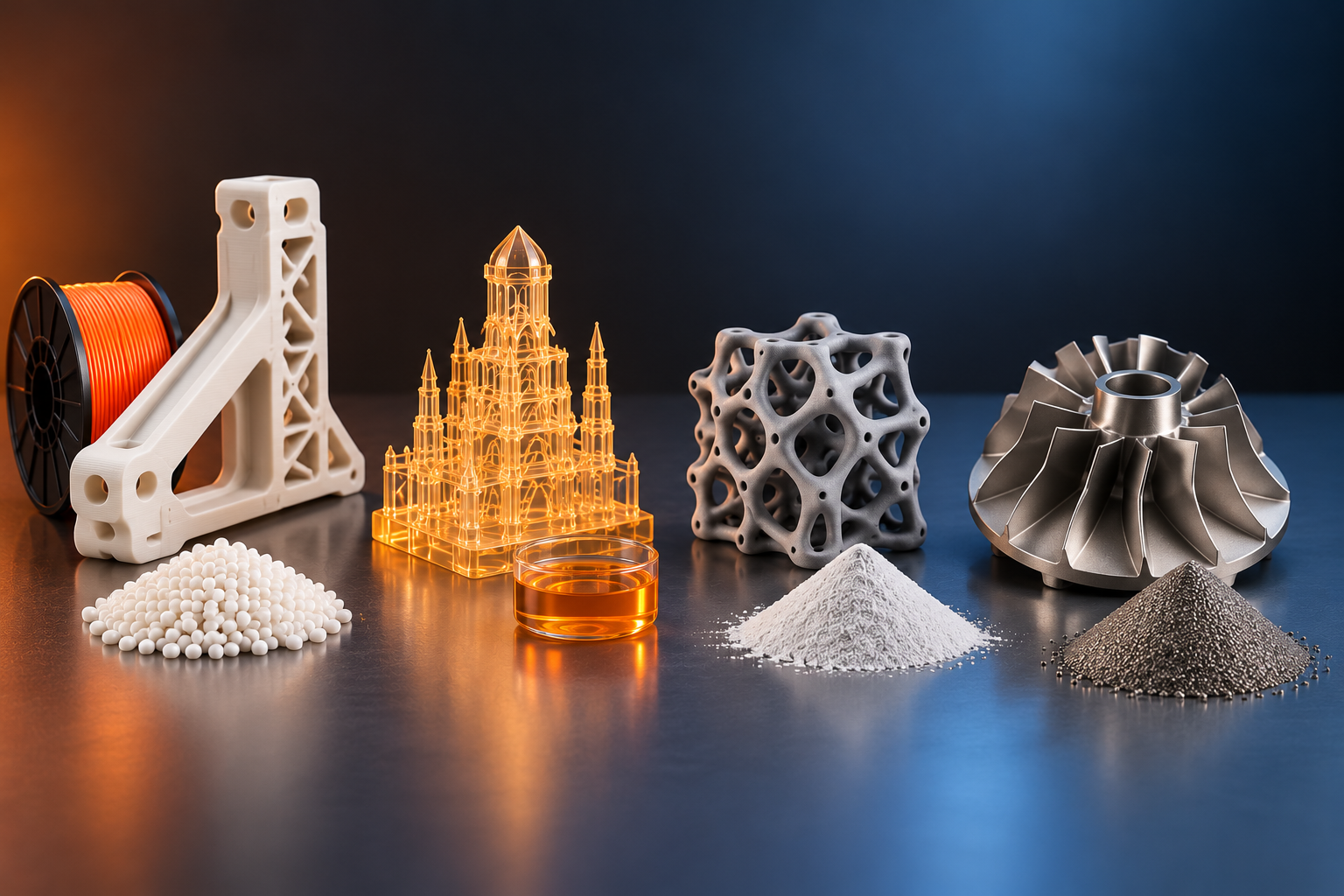
Additive manufacturing materials and applications
Polymers · Resins · Metal
● FDM / FFF · Material Extrusion● SLA / MSLA · Vat Photopolymerization● DLP · Vat Photopolymerization● SLS / MJF · Powder Bed Fusion● DMLS / SLM · Metal PBF● Binder Jetting● Material Jetting · PolyJet● DED · Directed Energy Deposition● Sheet Lamination● Bio 3D Printing● Food Printing · SSE● Construction AM● ISO/ASTM 52900● FDM / FFF · Material Extrusion● SLA / MSLA · Vat Photopolymerization● DLP · Vat Photopolymerization● SLS / MJF · Powder Bed Fusion● DMLS / SLM · Metal PBF● Binder Jetting● Material Jetting · PolyJet● DED · Directed Energy Deposition● Sheet Lamination● Bio 3D Printing● Food Printing · SSE● Construction AM● ISO/ASTM 52900
A complete reference for everyone exploring additive manufacturing — from first print to production.
9+
Major AM Technologies
FDM/FFF · SLA · DLP · SLS/MJF · DMLS/SLM · BJT · MJT · DED · SL
3+
Emerging & Specialized Domains
Bio · Food · Construction AM
6+
Material Categories
Polymers, Resins, Metals, Bio, Food, Composites
100+
Continuously Expanding Knowledge Base
Real-world applications
⚙️
Core Technologies
FDM/FFF · SLA · DLP · SLS/MJF · DMLS/SLM · BJT · Material Jetting · DED · Sheet Lamination
🧪
Materials Library
Properties, parameters, and applications for every major material family
🌱
Emerging Applications
Bio · Food · Construction AM — advanced and fast-growing application domains
ISO/ASTM 52900
Technologies are organized based on internationally standardized AM process categories. The label on each card indicates the official ISO/ASTM classification.
ISO/ASTM
Material Extrusion
FDM · FFF
ISO/ASTM
Vat Photopolymerization
SLA · DLP · MSLA
ISO/ASTM
Powder Bed Fusion
SLS · MJF · DMLS · SLM
ISO/ASTM
Binder Jetting
Sand · Metal · Ceramic
ISO/ASTM
Material Jetting
PolyJet · MJP
ISO/ASTM
Directed Energy Dep.
Laser DED · WAAM
ISO/ASTM
Sheet Lamination
LOM · UAM
Biofabrication
BIO
Bio 3D Printing
Uses bio-inks and living cells to create tissue structures for research and medical applications.
Biomedical · Tissue Engineering
Guide coming soon
Material Extrusion (Paste-Based)
SSE
Semi Solid Extrusion 3D Printing
Extrudes edible materials like chocolate, dough, and purees to create customized food products.
Food · Nutrition · Culinary
Guide coming soon
Large-Scale Material Extrusion
CON
Construction 3D Printing
Deposits concrete or similar materials to construct buildings and infrastructure.
Architecture · Civil · Scale
Guide coming soon
▸ Advanced domains pushing additive manufacturing beyond traditional boundaries.
▸ Materials define strength, flexibility, precision, and application suitability.
🏗️
Layer-by-Layer Learning
Theory → Process → Application
FDM
SLA
DMLS
SLS
MJF
Bio
01
Fundamentals First
Understand the core principles behind each additive manufacturing process.
02
Materials Understanding
Learn how different materials behave, and where they are best applied.
03
Process Clarity
From slicing to final part — understand every stage of the workflow.
04
Real Applications
Explore how industries actually use 3D printing in production and innovation.
05
Engineering Insights
Go beyond basics with practical knowledge used by professionals in the field.
🌱
Beginners
Start with clear, simple explanations of technologies and materials. No prior knowledge needed.
📚
Students
Use structured content for academic learning, projects, and research assignments.
⚙️
Engineers
Gain deeper understanding of processes, parameters, and real-world engineering applications.
🏢
Businesses
Explore how additive manufacturing can be integrated into real-world production workflows.
Start exploring additive manufacturing,layer at a time.
Structured knowledge across technologies, materials, and applications — completely free.
Browse Knowledge Base →
Free access. No login required.